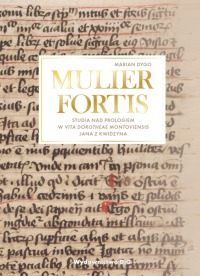
MESCO SENEX. Przyczynek do interpretacji Kroniki polskiej mistrza Wincentego
dostępnaOpis
Mesco Senex Mariana Dygi to pogłębiona, erudycyjna interpretacja opowiadania mistrza Wincentego o Mieszku III Starym – księciu wielkopolskim i kilkakrotnym księciu zwierzchnim Polski. Punktem wyjścia książki jest trwający od kilku dziesięcioleci spór historiograficzny dotyczący genezy i znaczenia prawa książęcego (ius ducale) oraz jego związku z rządami Mieszka Starego. Autor podejmuje jednak analizę całej Wincentyńskiej narracji o tym władcy, proponując lekturę Kroniki polskiej nie jako prostego zapisu faktów, lecz jako starannie skonstruowanego traktatu retoryczno-moralnego.
Książka ukazuje Mieszka Starego w całej złożoności jego literackiego wizerunku. Analiza prowadzi do wniosku, że obraz księcia jest bardziej konsekwentny, niż przyjmowano w części dotychczasowej historiografii: Wincenty przedstawia go jako władcę pozbawionego roztropności, wyniesionego przez Fortunę, uwikłanego w ideę doczesnej chwały i szczęścia, a zarazem stopniowo prowadzonego ku upadkowi. Szczególne znaczenie ma przeciwstawienie Fortuny i Opatrzności oraz cnót i ich braku w ocenie władcy.
Jednym z centralnych problemów książki jest pietas jako zasada porządku politycznego i społecznego. Autor pokazuje, że wokół niej kronikarz buduje opowieść o rządach Mieszka, „mężach Beliala”, przewrocie 1177 r., zabiegach o odzyskanie pryncypatu oraz bitwie nad Mozgawą w 1195 r. Odrzucenie pietas przeciwstawione zostaje postawie Kazimierza Sprawiedliwego i dostojników kościelnych, których działania wpisują się w porządek Opatrzności.
Analiza wykorzystuje narzędzia filologii, historii idei, retoryki i filozofii politycznej, uwzględniając klasyczne i chrześcijańskie koncepcje władzy, cnoty, losu, Fortuny i Opatrzności. Mesco Senex jest książką dla historyków średniowiecza, badaczy kultury łacińskiej, literatury dawnej i myśli politycznej, ale również dla czytelników zainteresowanych tym, w jaki sposób średniowieczna historiografia konstruowała sens przeszłości.
Français
Mesco Senex de Marian Dygo propose une interprétation approfondie et érudite du récit consacré par maître Vincent à Mieszko III l’Ancien, duc de Grande-Pologne et à plusieurs reprises princeps de Pologne. Le point de départ de l’ouvrage est le débat historiographique, poursuivi depuis plusieurs décennies, sur les origines et la signification du droit ducal (ius ducale) et sur son rapport avec le règne de Mieszko l’Ancien. L’auteur élargit toutefois son enquête à l’ensemble du récit de Vincent consacré à ce souverain et propose de lire la Chronique polonaise non comme un simple exposé des faits, mais comme un traité rhétorique et moral soigneusement construit.
L’ouvrage met en lumière toute la complexité de l’image littéraire de Mieszko l’Ancien. L’analyse conduit à considérer cette représentation comme plus cohérente qu’on ne l’a souvent admis dans l’historiographie : Vincent dépeint le prince comme un souverain dépourvu de prudence, élevé par la Fortune, attaché à la gloire et au bonheur terrestres, mais progressivement conduit à la chute. L’opposition entre Fortune et Providence, ainsi qu’entre les vertus et leur absence, constitue l’une des clés essentielles de l’interprétation.
La notion de pietas, conçue comme principe de l’ordre politique et social, occupe une place centrale. L’auteur montre comment le chroniqueur organise autour de cette notion son récit du règne de Mieszko, des « hommes de Bélial », du renversement de 1177, des tentatives de reconquête du principat et de la bataille de la Mozgawa en 1195. Le rejet de la pietas est opposé à l’attitude de Kazimierz II le Juste et des dignitaires ecclésiastiques, dont l’action s’inscrit dans l’ordre de la Providence.
L’analyse mobilise les méthodes de la philologie, de l’histoire des idées, de la rhétorique et de la philosophie politique, en tenant compte des conceptions antiques et chrétiennes du pouvoir, de la vertu, du destin, de la Fortune et de la Providence. Mesco Senex s’adresse aux historiens du Moyen Âge, aux spécialistes de la culture latine, de la littérature ancienne et de la pensée politique, mais aussi à tous ceux qui s’intéressent à la manière dont l’historiographie médiévale construisait le sens du passé.
English
Mesco Senex by Marian Dygo offers an in-depth and erudite interpretation of Master Wincenty’s account of Mieszko III the Old, Duke of Greater Poland and, on several occasions, princeps of Poland. The book takes as its point of departure the long-standing historiographical debate over the origins and significance of ducal law (ius ducale) and its relationship to Mieszko the Old’s rule. The author, however, extends the inquiry to Wincenty’s entire narrative concerning this ruler, reading the Polish Chronicle not as a straightforward record of events but as a carefully constructed rhetorical and moral treatise.
The book reveals the full complexity of Mieszko the Old’s literary image. Its analysis suggests that this image is more coherent than has often been assumed in previous scholarship: Wincenty portrays the prince as an imprudent ruler, elevated by Fortune, entangled in the pursuit of earthly glory and happiness, yet gradually led towards downfall. The opposition between Fortune and Providence, as well as between virtue and its absence, forms one of the principal keys to the interpretation.
A central theme of the book is pietas as a principle of political and social order. Dygo shows how the chronicler organizes his narrative of Mieszko’s rule, the “men of Belial”, the overthrow of 1177, the attempts to recover the principate, and the battle on the Mozgawa River in 1195 around this concept. The rejection of pietas is contrasted with the conduct of Kazimierz II the Just and of leading churchmen, whose actions are presented as consonant with the order of Providence.
The analysis draws on philology, the history of ideas, rhetoric, and political philosophy, taking into account classical and Christian concepts of power, virtue, fate, Fortune, and Providence. Mesco Senex will be of interest to medieval historians, scholars of Latin culture, early literature, and political thought, as well as to readers interested in the ways medieval historiography constructed and interpreted the meaning of the past.
Latine
Mesco Senex Mariani Dygo interpretationem accuratam atque eruditam narrationis a magistro Vincentio de Mescone, qui Senex appellatur, duce Maioris Poloniae et saepius principe Poloniae, compositae praebet. Initium investigationis est controversia historiographica iam diu agitata de origine atque significatione iuris ducalis (ius ducale) eiusque nexu cum principatu Mesconis. Auctor tamen non solum hanc quaestionem tractat, sed totam narrationem Vincentianam de hoc principe examinat, Chronicon Polonorum non tamquam simplicem rerum gestarum relationem, sed tamquam opus rhetorice et moraliter ordinatum interpretans.
Ex hac analysi imago Mesconis, qui Senex appellatur, magis constans apparet quam a nonnullis rerum gestarum investigatoribus antea existimatum est. Princeps a Vincentio imprudens atque virtutibus carens, Fortuna elatus atque gloriae felicitatisque terrenae cupidus depingitur, qui paulatim ad ruinam ducitur. Oppositio inter Fortunam et Providentiam divinam, itemque inter virtutem et vitia, ad intellectum huius narrationis maximi momenti est.
Praecipuum quoque locum obtinet pietas, quae tamquam fundamentum ordinis politici ac socialis exponitur. Auctor demonstrat quomodo circa hanc notionem Vincentius narrationem de principatu Mesconis, de viris Belial, de mutatione rerum anno 1177 facta, de conatibus principatus recuperandi atque de pugna ad Mozgavam anno 1195 commissa componat. Defectus pietatis opponitur actionibus Casimiri Iusti atque praelatorum Ecclesiae, quae cum ordine Providentiae divinae congruere ostenduntur.
Investigatio subsidiis philologiae, historiae idearum, rhetoricae atque philosophiae politicae utitur atque notiones antiquas et Christianas de potestate, virtute, fato, Fortuna et Providentia complectitur. Mesco Senex non solum historicis medii aevi et cultus Latini investigatoribus, sed etiam iis commendatur qui intellegere cupiunt quomodo historiographia mediaevalis praeteritis rebus sensum tribuerit.
Spis treści
- Wstęp 9
- Rozdział 1. Mieszko Stary na szczycie pomyślności 15
-
- 1.1. „Pochopniejszy i w mowie popędliwszy” 15
- 1.2. „Uczestnik wszelkich szczęśliwości” 31
- 1.3. „Powstali mężowie Beliala” 43
- 1.4. „Niedźwiedzia w kniei zabiłeś?” 62
- 1.5. „Przyjął w posłuszeństwo przybysza czy obcego” 83
- 1.6. „Scholarze przypadkiem uderzyli Żyda” 98
- 1.7. „Oskarżą cię o kradzież bydła” 108
- 1.8. „Oddaj, coś winien!” 113
- Rozdział 2. Mieszko Stary na dnie upadku 130
-
- 2.1. „Natchniony przez Boga biskup” 130
- 2.2. „Opuszczony niemal przez wszystkich” 149
- 2.3. „Nasza tu dzieje się krzywda” 164
- 2.4. „Zapaliło się jego serce do odzyskania pryncypatu” 178
- 2.5. „Radował się ciepłem braterskich objęć” 194
- Rozdział 3. Mieszko Stary wywyższony i haniebnie poniżony 207
-
- 3.1. „Dziecię wybierają na princepsa” 207
- 3.2. „Wzajem się zabijają w zamęcie rzezi” 223
- Zakończenie 240
- Wykaz skrótów 245
- Bibliografia 247
-
- 1. Źródła 247
- 2. Opracowania 251
- Mesco Senex: Interpreting Master Wincenty’s Polish Chronicle afresh — Summary 273
- Indeks nazw osobowych 276
Inne publikacje autorów
Z tego samego działu